
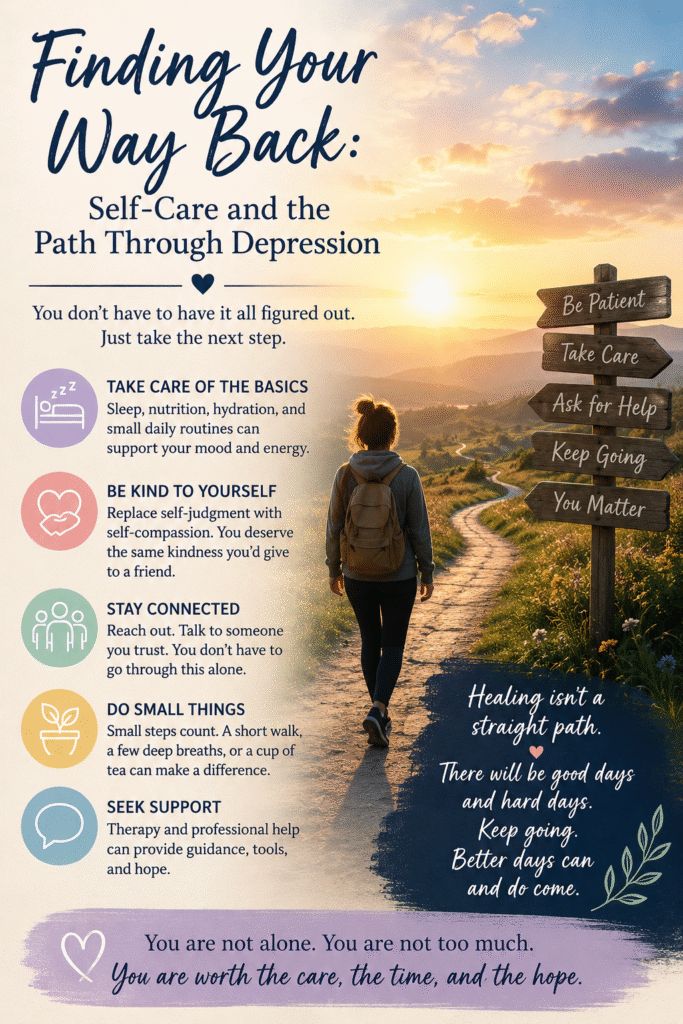
Depression doesn’t announce itself politely. It creeps into the small things first — the shower that feels like too much effort, the phone calls you keep meaning to return, the hobbies that used to bring you joy but now just sit there, untouched. For anyone who has lived through it, or is living through it now, one thing becomes clear fast: depression is not a mood you can simply decide to shake off. But it is something you can move through, with the right support, patience, and tools.
This article looks at what self-care actually means in the context of depression — not the bubble-bath, candle-lit version often sold to us, but the real, sometimes unglamorous work of tending to yourself when everything in you wants to give up.
Understanding What You’re Working With
Before diving into strategies, it helps to be honest about what depression actually does. It affects energy, motivation, concentration, sleep, appetite, and the ability to feel pleasure in things that once mattered. It can distort thinking, making the situation feel more permanent and hopeless than it is. This isn’t a character flaw or a sign of weakness — it’s a genuine shift in how the brain and body are functioning, often influenced by biology, life circumstances, stress, grief, or a combination of all three.
If you’re navigating something like this yourself, it’s worth naming that plainly to a doctor or therapist rather than trying to self-diagnose or push through alone. A professional can help identify what’s going on and what combination of support — therapy, medication, lifestyle changes, or all three — might actually help. This article can offer ideas, but it isn’t a substitute for that kind of care.
Why “Self-Care” Gets a Bad Reputation — and What It Really Means
The term self-care has been stretched thin by marketing until it mostly means spa days and face masks. That version of self-care isn’t wrong, but it’s incomplete, and it can feel almost insulting when you’re in the thick of depression and someone suggests you “just take a bath.”
Real self-care, especially during depression, is closer to basic maintenance than indulgence. It’s the unglamorous stuff:
- Getting up and getting dressed, even if you’re not going anywhere
- Eating something, even if it’s not a full meal
- Drinking water
- Getting outside for five minutes
- Texting one person back
- Going to bed at a consistent time
These sound almost embarrassingly small. But when depression has hollowed out your capacity to function, these small acts are the scaffolding that everything else gets built on. The goal isn’t to leap to “thriving” — it’s to keep the basic systems running so recovery has somewhere to take root.
Building Blocks That Actually Help
1. Movement, in Whatever Form Is Available to You
Physical activity is one of the most well-supported tools for easing depressive symptoms, not because it’s a cure, but because movement changes brain chemistry, discharges stress hormones, and often interrupts the loop of rumination. This doesn’t mean forcing yourself into a punishing workout routine — a slow walk around the block counts. So does stretching on the floor, dancing badly around your kitchen, or doing a few minutes of yoga. The goal is consistency over intensity.
2. Sleep as a Non-Negotiable
Depression and sleep have a tangled, bidirectional relationship — poor sleep worsens depressive symptoms, and depression disrupts sleep. Where possible, protecting a consistent sleep and wake time, limiting screens before bed, and creating a calm wind-down routine can make a meaningful difference. If insomnia or oversleeping is a significant issue, it’s worth raising directly with a doctor, since it’s often treatable on its own.
3. Nutrition, Gently
Depression often kills appetite or swings it into overdrive. Rather than aiming for a “perfect” diet, the more realistic goal is regularity — eating something at roughly consistent times, even small amounts, and not skipping meals for long stretches, which can worsen fatigue and irritability. Simple, low-effort foods you can make without much willpower (think: a boiled egg, a piece of fruit, a smoothie) are often more sustainable than ambitious meal plans during a hard stretch.
4. Reducing the Isolation Spiral
Depression tends to whisper that withdrawal is safer, that people are better off without your low energy, that connection takes more than you have to give. Isolation almost always deepens depression rather than easing it. The antidote doesn’t need to be a big social outing — it can be as small as replying to one message, sitting in the same room as another person without talking, or attending a support group where you don’t have to perform wellness.
5. Structuring Time in Small, Doable Chunks
Depression can make time feel shapeless and overwhelming — a wall of hours with nothing to hold onto. Breaking a day into small, achievable chunks (even just “get up,” “eat breakfast,” “step outside”) can create a sense of forward motion. Some people find it useful to write these down and cross them off, not for productivity’s sake, but as visible proof that they did something.
6. Limiting the Comparison Trap
Social media, in particular, can quietly deepen depressive feelings by fueling comparison — everyone else’s highlight reel against your hardest days. It’s worth noticing whether certain apps or accounts consistently leave you feeling worse, and giving yourself permission to step back from them, at least while you’re finding your footing.
7. Naming It Out Loud
Whether to a therapist, a trusted friend, a support group, or even a journal, putting words to what you’re experiencing can loosen its grip. Depression thrives in secrecy and shame; naming it — “I’m struggling right now” — is often the first real act of resistance against it.
Professional Support Isn’t a Last Resort
One of the most persistent myths about depression is that therapy or medication are for “severe” cases only, and that self-care alone should be enough if you’re just trying hard enough. In reality, professional support is often what makes self-care possible in the first place — therapy can help build the tools and insight you need to actually implement lifestyle changes, and for many people, medication corrects an imbalance that no amount of willpower alone can fix.
If you haven’t already, consider reaching out to a doctor or therapist, especially if:
- Symptoms have lasted more than two weeks
- Daily functioning — work, relationships, basic care — is significantly affected
- You’ve noticed thoughts of hopelessness, self-harm, or not wanting to be alive
There is no shame in needing outside help. Depression is a medical and psychological experience, not a test of character.
Patience With the Process
Recovery from depression is rarely linear. There will be days that feel like real progress and days that feel like a slide backward, sometimes within the same week. This isn’t failure — it’s simply how healing tends to work. The aim isn’t perfection; it’s building a life with more good days woven into it, and more tools on hand for the harder ones.
If you take nothing else from this, let it be this: the small things you do for yourself when you feel like doing nothing are not insignificant. They are, in fact, the entire foundation recovery is built on.
This article is intended for general educational purposes and isn’t a substitute for professional diagnosis or treatment. If you’re personally navigating depression or a difficult mental health period, consider reaching out to a doctor, therapist, or counselor — they can help you find the right kind of support for your situation.