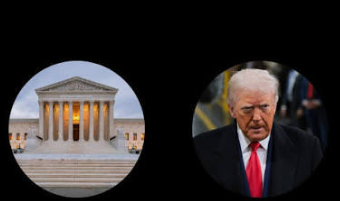
The United States Supreme Court dealt a sweeping rebuke to President Donald Trump on Monday, ruling by six votes to three that his executive order seeking to end automatic citizenship for children born on American soil was unconstitutional, leaving intact a principle that has defined American identity for more than a century and a half.
Chief Justice John Roberts wrote the majority opinion in the case, known as Trump v. Barbara, tracing the right to citizenship at birth through English common law, the ratification of the Fourteenth Amendment in 1868, and the court’s own landmark 1898 ruling in United States v. Wong Kim Ark. The six-justice majority — which included the court’s three liberal justices joined by Roberts and two of his conservative colleagues — concluded that children born in the United States to parents unlawfully present or on temporary legal status are “subject to the jurisdiction” of the United States within the meaning of the Fourteenth Amendment and are therefore citizens at birth.
Roberts noted in his opinion that Congress had repeatedly had the opportunity to narrow the definition of birthright citizenship and had declined to do so, most recently when it codified the principle in the Immigration and Nationality Act of 1952. He also observed that even during periods of intense hostility toward immigrants, including during the forced internment of Japanese Americans in World War II, the citizenship of children born on American soil was never questioned.
The Trump administration had argued that the Fourteenth Amendment’s citizenship guarantee was written narrowly to address the status of newly freed slaves after the Civil War, and was never intended to cover children of temporary visitors or undocumented parents. Administration lawyers further contended that the concept of “permanent domicile” — rather than physical presence alone — was the true test of citizenship under the amendment. The majority firmly rejected that reading.
Justice Samuel Alito, writing in dissent and joined by two fellow conservatives, said the majority had committed a serious error, calling the decision a missed opportunity to correct what he described as a longstanding misreading of the constitutional text.
Trump had predicted the loss before the ruling was announced, publicly attacking his own appointees on social media in anticipation of the outcome. Reacting after the decision was handed down, he called it “too bad for our Country” and immediately pivoted to Congress, urging Republican lawmakers to pass legislation restricting birthright citizenship and pledging his full support. Legal analysts said that path faces steep hurdles: poll after poll has shown strong public support for birthright citizenship, and several justices in the majority suggested in their reasoning that a constitutional amendment — not ordinary legislation — would be the only permissible route to changing the rule.
The case was brought by the American Civil Liberties Union and allied groups on behalf of children whose citizenship had been thrown into uncertainty by Trump’s order, which he signed on his first day back in the White House on January 20, 2025. Lower courts had unanimously blocked the order from taking effect, and the ruling on Monday permanently extinguishes it.