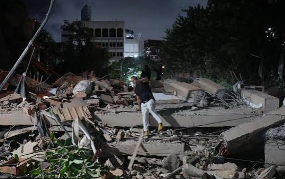
Two powerful earthquakes struck Venezuela back to back on Wednesday evening, just minutes apart,
causing buildings to collapse in the capital, Caracas, and triggering a state of emergency. According to the US Geological Survey, the first quake measured magnitude 7.1, centered near the town of San Felipe roughly 100 miles west of Caracas, and was followed only about 39 seconds later by an even larger magnitude 7.5 quake near the nearby town of Yumare. Both hit shortly after 6 p.m. local time. The USGS itself warned that high casualties and widespread damage were likely given the size of the event.
These are being described as among the strongest earthquakes to hit Venezuela in more than a hundred years, which is notable because the country doesn’t normally see quakes of this scale — unlike Pacific coast nations such as Mexico and Chile that sit along the highly active “Ring of Fire,” Venezuela’s location straddling the South American and Caribbean tectonic plates usually makes major earthquakes far less frequent there.
The quakes struck while many Venezuelans were home for a public holiday marking the 1821 military victory that secured the country’s independence from Spain. In Caracas, residents described buildings swaying violently from side to side, and many ran outside as walls came down, in some cases exposing furniture and interiors to the street. Dust clouds were seen rising over at least two neighborhoods in the capital, including areas normally busy with restaurants and shops. The hardest-hit area mentioned so far is the Altamira neighborhood, where Interior Minister Diosdado Cabello said there were collapsed homes and buildings and what he called “alarming situations,” suggesting injuries had occurred. He asked residents to be especially careful with children and the elderly, urged people to stay outside because aftershocks could bring down already-weakened structures, and asked drivers to clear the way for ambulances and rescue vehicles.
President Delcy Rodriguez declared a national state of emergency, closed the main airport in Caracas due to damage, and said in televised remarks that at least 20 aftershocks had already been recorded. She offered condolences to families who had lost loved ones, though authorities have not yet released official casualty figures. Outside seismologists, including Lucy Jones of Caltech, said the event’s combination of sheer magnitude and the fact that it struck a densely populated area makes it likely to be an unusually severe and damaging disaster. The USGS confirmed there is no tsunami threat from the quakes.