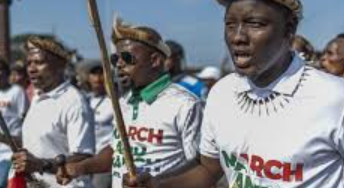
South African authorities placed police on heightened alert on Tuesday as anti-immigration groups pressed ahead with threatened nationwide protests, after weeks of attacks on foreign nationals left several people dead and forced thousands to flee their homes.
The protest movement, led by a coalition calling itself March and March, had set Tuesday as a deadline for undocumented migrants to leave the country and called for a “national shutdown” if the government failed to act on immigration. Demonstrations were already under way in parts of Johannesburg and Durban.
Acting Police Minister Firoz Cachalia said law enforcement agencies had cancelled leave and deployed additional resources, with police mounting a major operation ahead of the protests. The Institute for Security Studies warned of a moderate to high risk of localized violence in Gauteng, parts of the Western Cape and KwaZulu-Natal.
The unrest has already proven deadly. A Malawian man was beaten to death in Pietermaritzburg, and two Mozambican nationals were killed in late May in Mossel Bay, where dozens of shacks in an informal settlement were burned. Mozambique’s government described the deaths as xenophobic attacks.
South Africa’s Border Management Authority said more than 13,000 foreign nationals, including roughly 9,000 Malawians and 3,000 Zimbabweans, have been voluntarily repatriated or deported over the past two weeks. Home affairs officials said nearly 9,500 people had been moved out of Durban alone, with thousands more awaiting processing at a temporary site in the city.
President Cyril Ramaphosa met over the weekend with Zulu monarch King Misuzulu kaZwelithini to discuss the unrest and asked him to call for peaceful protest. Ramaphosa has said the government will not tolerate attempts to destabilize the country and has blamed the violence on what he called opportunists exploiting genuine economic grievances among poor South Africans.
Civil society groups, including Lawyers for Human Rights, said the campaign has also swept up migrants with legal refugee status, and that fear has driven many into hiding. The South African Federation of Trade Unions urged workers to report for duty as normal and called on the government to act against intimidation and unlawful disruption.
The unrest comes ahead of local elections later this year and echoes, though has not yet reached the scale of, xenophobic riots in 2008 that killed 62 people and displaced more than 100,000.