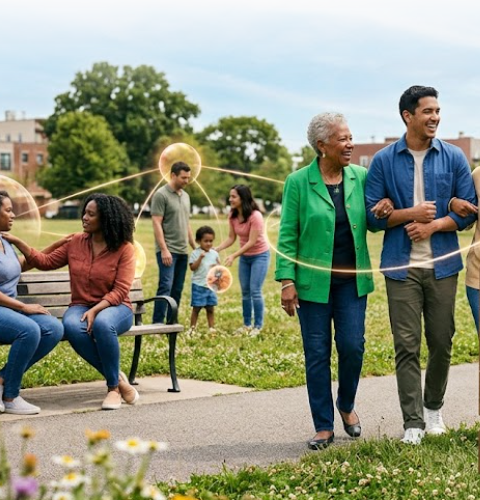
Most people think of a “support system” as a soft, sentimental idea — the friends you’d call if your car broke down, the family member who shows up with soup when you’re sick. Research over the past two
decades suggests this framing badly undersells what’s actually going on. A personal support system is one of the most consistently replicated predictors of mental health, physical health, and even lifespan that behavioral science has identified. It belongs in the same conversation as diet, exercise, and sleep, not as an afterthought to them. This article pulls together what researchers, clinicians, and public health officials currently understand about personal support systems: what they’re made of, why they matter so much, what happens when they’re missing, and how to deliberately build one.
Psychologists define social support as the resources a person believes are available to them, or that are actually provided by their social network, to help them cope, function, and thrive. Researchers have repeatedly identified the same handful of categories across decades of study. Emotional support means being listened to, comforted, and made to feel understood, accepted, and secure; it creates a felt sense of safety and acts as a genuine health-promoting resource, not just a nice-to-have. Informational support is advice and guidance, the kind of practical know-how that helps someone make a decision or solve a problem. Esteem support is feedback and encouragement that increases a person’s sense of competence and self-worth. Tangible or instrumental support is concrete help, such as transportation, childcare, money, or a place to stay. And companionship or network support comes simply from belonging to a group and sharing experiences, which is distinct from one-on-one emotional support. A healthy support system isn’t one giant category of “people who like you” — it’s a portfolio, with different people serving different functions. A 2025 study of UK university students made this structural point explicit: what predicted better mental health and a greater willingness to seek help wasn’t just how many people a student knew, but the diversity of relationship types and support types in their network, combined with how much support they actually perceived as available to them. Network size matters less than people assume; the mix and the perceived reliability of that mix matter more.
The most cited finding in this entire field comes from a 2010 meta-analysis by Julianne Holt-Lunstad and colleagues, which pooled 148 studies covering more than 308,000 people. Across those studies, people with stronger social relationships had a 50% greater likelihood of survival than those with weaker ones, an effect size large enough that the researchers concluded social relationships influence mortality risk to roughly the same degree as well-established risk factors like smoking. A 2015 follow-up by the same team, covering over 3.4 million participants, broke that risk down further: loneliness was linked to a 26% increase in risk of early death, social isolation to a 29% increase, and living alone to a 32% increase. The comparison that gets repeated in public health circles, that the mortality impact of lacking social connection is similar to smoking up to 15 cigarettes a day, comes directly from this body of work. The disease-specific picture is just as concrete. The U.S. Surgeon General’s 2023 advisory on loneliness and isolation noted that poor social connection is associated with a 29% greater risk of coronary heart disease and a 32% greater risk of stroke, that smaller social networks are linked to a higher risk of developing type 2 diabetes, and that weak social support has been shown to worsen the severity of illness following viral infections. Isolation and loneliness are also independent risk factors for dementia, depression, and premature mortality from all causes.
Outside of mortality statistics, the “stress-buffering” model is the dominant explanation for why support matters so much. The theory holds that social support acts as a moderator, helping people withstand the psychological and physiological toll of stressors that would otherwise wear them down. This isn’t just theoretical: a 2024 study of healthcare workers found that perceived social support directly reduced anxiety symptoms tied to pandemic-era work stress, and a separate 2024 study of medical staff found that social support helped explain the link between psychological resilience and better sleep quality. Another 2024 study from the COVID-19 period found that higher social support was associated with lower burnout, while resilience alone, without the social support component, was not enough to explain who burned out and who didn’t. Resilience, in other words, isn’t purely an individual trait a person either has or lacks; it’s substantially built and sustained through relationships with other people.
The flip side of this research is what happens when support systems erode, and the data here has become significant enough that U.S. Surgeon General Vivek Murthy formally declared loneliness and isolation a public health epidemic in 2023. Social connection, the structure, function, and quality of a person’s relationships, is, in his framing, an underappreciated contributor to health, safety, and resilience at both the individual and community level. The scale is large: roughly half of U.S. adults reported experiencing loneliness even before the COVID-19 pandemic, and the pandemic made it worse. Gallup polling has found that one in five American adults report feeling lonely every single day. Young adults are disproportionately affected; in one widely cited 2021 survey, 79% of adults aged 18 to 24 reported loneliness, compared with 41% of adults over 66. Murthy has pointed to social media as part of the explanation, arguing that connection quality, not quantity, determines loneliness, and that many young people have effectively swapped confidants for contacts, and friends for followers. The economic and societal costs are measurable too: social isolation among older adults alone is estimated to account for roughly $6.7 billion in excess Medicare spending each year, largely driven by increased hospitalizations and nursing facility use, and loneliness and isolation are now described as more widespread in the population than smoking, obesity, or diabetes. It’s worth noting that loneliness and isolation aren’t the same thing. Isolation is a structural fact, a matter of how many people you interact with. Loneliness is subjective, a distressing gap between the connection you want and the connection you actually have. That distinction matters practically, because it means someone can be surrounded by family and still feel lonely if they don’t feel seen by them, and someone with a small network can feel entirely supported if that network reliably meets their needs.
The research literature and clinical guidance converge on a few consistent, practical principles for building or rebuilding a personal support system. The first is to build the network before you need it: support systems work best as standing infrastructure rather than emergency response, and waiting until a crisis hits to start building connections makes an already hard moment harder. The second is to diversify rather than simply expand. Because different relationships serve different functions, emotional, practical, professional, a support system built around one or two people, however close, is fragile; spreading needs across multiple relationship types, such as family, close friends, a therapist, a faith or hobby community, and coworkers, tends to produce steadier support than relying on a single source for everything. The third is to use shared activity as the entry point, since new connections form more reliably around recurring shared activity than around the abstract goal of “making friends” — group fitness classes, volunteering, faith or spiritual communities, and recurring interest groups all create the kind of repeated, low-stakes contact that relationships need to develop. The fourth is to treat professional support as a distinct category rather than a replacement: a therapist or counselor is not a substitute for friends or family, but functions differently from both, serving as an unbiased party who can help identify gaps in an existing support network and coach someone through the discomfort of building new connections, particularly when social anxiety or low self-esteem make reaching out harder. The fifth is to give support, not just receive it, since reciprocity is consistently described as one of the fastest ways to deepen a thin network. The sixth is to maintain the system when things are going well, not only when they’re not, because people often pull back from their support network the moment things improve, only to find themselves isolated again the next time a crisis hits. And the seventh is to be honest about who belongs in the system, since not every existing relationship is supportive, and part of building one deliberately is recognizing which relationships drain rather than sustain, and adjusting expectations or boundaries accordingly.
These dynamics show up differently depending on context. At work, the stress-buffering effect appears clearly in occupational research: among tourism employees navigating pandemic-era job instability, social support was directly linked to lower employment stress, with the effect partly explained by more positive coping styles and personal resilience. The implication for workplaces is straightforward — managers and organizations that foster genuine peer connection and psychological safety aren’t just improving morale, they’re affecting a measurable stress-buffering mechanism. In recovery and major life transitions, whether addiction recovery, grief, chronic illness, or divorce, clinical literature consistently recommends layering multiple support types: family and friends for day-to-day emotional and practical support, peer support groups for the validation of shared experience, and professional counseling for structured, unbiased guidance. The redundancy is the point; if one source becomes unavailable, the system as a whole still holds. Online and digital communities increasingly function as legitimate, if different, sources of support. Research comparing forum-based and chat-based peer support communities has found that informational and emotional support dominate in digital spaces, while the more logistics-heavy categories, tangible support, esteem support, and network support, show up less often online than offline. Digital support is real, but it tends to supplement rather than replace the practical and in-person dimensions of a support system.
The data converges on a conclusion that’s easy to state and harder to act on: a personal support system functions less like an emotional luxury and more like a biological necessity, with measurable effects on stress hormones, immune function, cardiovascular risk, and ultimately lifespan. The good news embedded in this research is that support systems are buildable. They aren’t fixed by personality or luck; they’re built through deliberate, repeated, often unglamorous effort, showing up, reaching out first, diversifying who you rely on, and treating your relationships as something to maintain even when nothing is wrong.
If you’re going through a difficult time and feel you don’t have anyone to turn to, you’re not alone in that experience — many people have rebuilt support over time, often starting with a single relationship or a mental health professional. If you’d like, I can point you toward resources for finding support in your area.