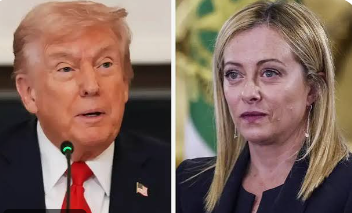
A dispute that began over a single photograph at the G7 summit has turned into an open and increasingly personal feud between President Donald Trump and Italian Prime Minister Giorgia Meloni,
two leaders who had previously been viewed as close political allies. The friction started after Trump told an Italian broadcaster that Meloni had pleaded with him repeatedly for a photo together during the summit in Evian-les-Bains, France, suggesting he only agreed because he felt sorry for her. Meloni rejected the account outright, calling it entirely invented and saying she was genuinely taken aback that a fellow head of state would describe an ally that way, adding that she could not understand why Trump treated partners this way while often showing far more patience toward governments openly hostile to the West.
Rather than letting the dispute fade, Trump escalated it over the following days. He posted publicly that Meloni had asked for the photo over and over, argued that her domestic popularity in Italy was slipping, and suggested she was only trying to repair their relationship now because she wanted a political boost following the recent U.S. military action against Iran. Meloni answered directly and pointedly, telling Trump that the repeated attacks made no sense and that being associated with him had done nothing to help her standing with Italian voters in the first place. She added that her popularity has nothing to do with him at all, and comes instead from her record of defending Italy’s interests, pointing specifically to her government’s handling of requests around American use of Italian airbases. She closed by telling Trump plainly that her popularity was not his concern, and that he should worry about his own instead.
Underlying the photo dispute is a more substantive disagreement. Trump has voiced frustration that Italy refused to let American bombers use a base in Sicily during the recent operation against Iran without first getting parliamentary approval, a decision Meloni has defended as a matter of constitutional process and domestic political reality rather than a lack of support for Washington. Trump has cast that decision as evidence that Italy and other NATO members failed to back the U.S. when it mattered, a longstanding complaint of his about the alliance’s burden-sharing. The disagreement has had diplomatic consequences beyond the public sparring: Italy’s foreign minister canceled a planned trip to the United States as the spat unfolded, and Meloni’s government has lined up publicly behind her.
The clash marks a notable shift for two leaders whose relationship had been seen as unusually warm by European standards. Meloni was the only European head of government to attend Trump’s second inauguration, and her right-wing political brand had made her something of a natural bridge between the Trump White House and a European continent that has often kept the administration at arm’s length. That goodwill had already been tested earlier this year, when Meloni criticized Trump’s public criticism of Pope Leo XIV over the pontiff’s opposition to the Iran war, prompting Trump to accuse her of lacking courage. The G7 photo dispute has now pushed an already strained relationship further into open conflict, playing out not through diplomatic channels but through dueling social media posts and television interviews.
Polling cited alongside the dispute suggests both leaders have something to defend. Meloni’s approval has reportedly climbed back to around the mid-30s after a decline last year, with her Brothers of Italy party still leading Italian polling, while Trump’s own approval has ticked up only slightly and remains near the lowest point of his political career, with cost-of-living concerns continuing to weigh on his numbers. Whether the public feud cools before next month’s NATO summit, where both leaders are expected to appear, remains an open question.